

What Is Yarn Weight?
Yarn weight refers to the thickness or diameter of a strand of yarn and plays a crucial role in the final look and feel of your finished project. Understanding the yarn weight system is essential because it directly affects the tension, gauge, and drape of your work.
Selecting a suitable yarn for a project
When selecting yarn for a specific design, it's important to consider not just the weight but also the fiber content, as this will impact both the behavior of the yarn when worked and the overall outcome of your piece. Familiarizing yourself with the concept of yarn weight as well as the information on the yarn label ensures that your projects not only meet your creative vision but also maintain the structural integrity you desire. The Craft Yarn Council is an excellent additional resource.
Understanding Ply vs. Weight
It's important to understand the difference between ply and weight, as these two factors significantly influence your project’s final outcome. Ply refers to the number of strands twisted together to create a yarn. For example, a two-ply yarn consists of two strands, providing a loftier texture than a single ply. On the other hand, weight indicates the thickness or density of the yarn, often classified into standard categories like lace, fingering, or bulky. However, variations and terminologies can differ across regions; for instance, a yarn labeled as "worsted" in the U.S. may be referred to as "aran" in the UK.
Yarn Weight Categories & Best Suited Projects
- Lace weight - the lightest weight of yarn, typically ranging from 0 to 3 ply, lace yarn is ideal for intricate, lightweight creations like delicate shawls or doilies where an airy feel is desired.
- Super fine weight - also known as fingering or sock weight, works beautifully for projects like eyelet shawls and cozy socks
- Fine weight - other names include sport weight, baby weight, or light DK weight yarn is suitable for projects like baby items, light sweaters ,etc.
- Light weight yarn - or DK yarn (double knit) is slightly thicker, and they're best used for children's garments, sweaters and accessories
- Medium weight yarn - Also known as worsted weight or Aran, plays a versatile role and is ideal for a wide range of projects, from blankets to cozy sweaters and just about any adult garment
- Bulky weight - also known as chunky or rug yarn is great for working up quick projects like rugs, heavy sweaters or blankets, or chunky scarves
- Super bulky weight - Ideal for very chunky blankets
Yarn Weight Charts by Craft
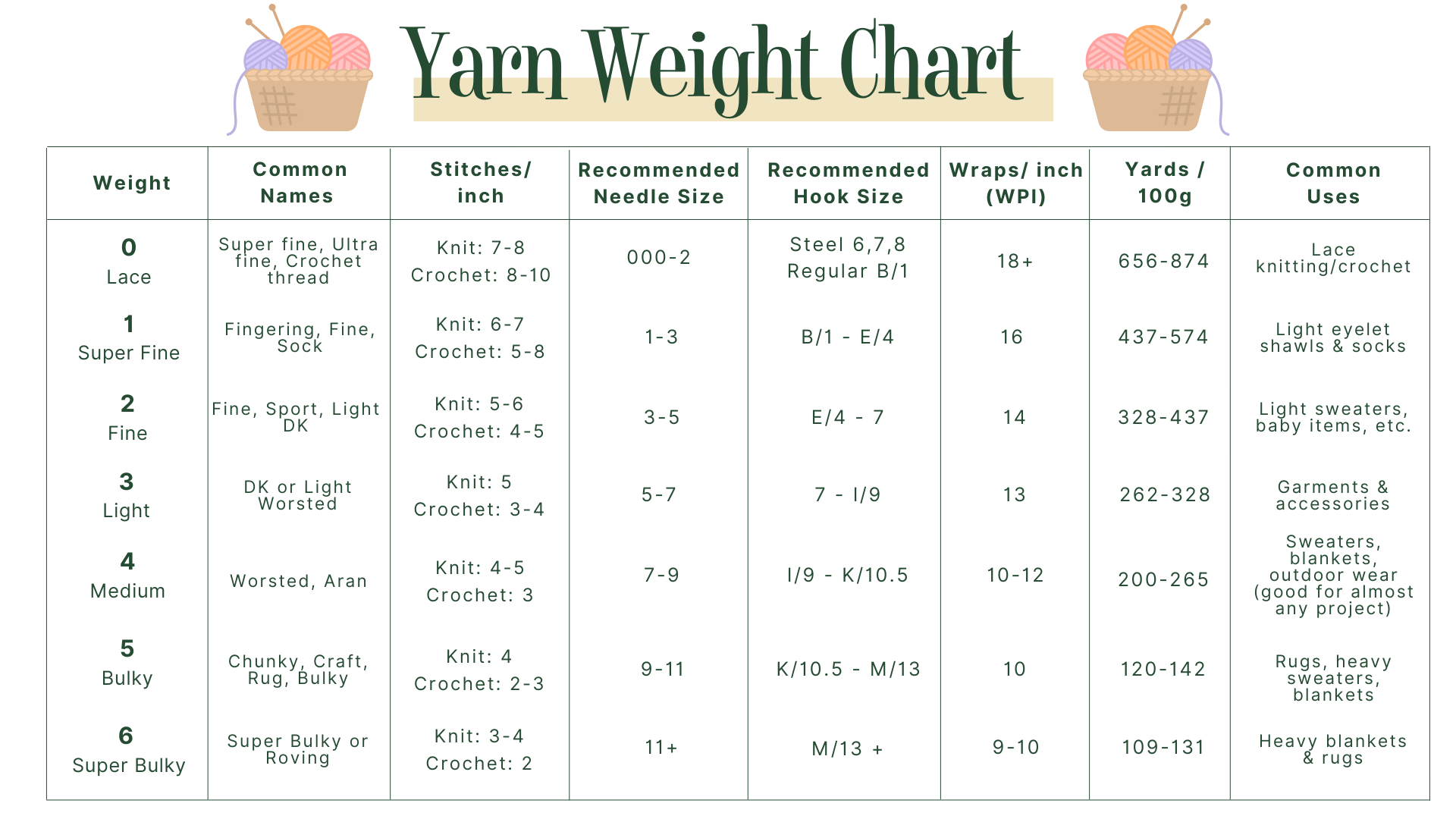
Choosing the right yarn for your project can be overwhelming. A yarn weight chart is invaluable, as it outlines the different weights and their recommended uses. To read and understand different yarn weight categories from a chart, look for the corresponding WPI or listed weight (such as lace, fingering, sport, worsted, or bulky) in the chart. Each category usually includes a range of recommended WPI and sometimes suggested needle or hook sizes, making it easier to match your yarn choice with your project requirements.
Knitting & Crochet Yarn Weight Chart
Recommended Hook and Needle Sizes for Each Yarn Weight
When it comes to achieving the best results in your knitting or crochet projects, selecting the appropriate hook and needle sizes for your chosen yarn weight is essential. Each yarn weight category comes with its own recommended sizes to optimize the overall appearance and functionality of your work. For instance, lace weight yarn typically pairs well with smaller needles or hooks, often between 1.0 mm to 3.0 mm, which allows for the delicate and airy fabric desired in lace projects. On the other hand, worsted weight yarn usually recommends sizes around 4.0 mm to 5.5 mm to create a sturdy yet versatile structure suitable for a variety of garments. For bulky yarns, larger hooks and needles, often between 6.0 mm and 12.0 mm, yield the cozy and plush results many crafters look for in blankets and oversized sweaters. It’s also important to consider personal tension and gauge when selecting your tools. Always remember that these recommendations serve as guidelines, and the most effective choice will come from experimenting with your individual yarn and personal crafting style.
Weaving Weight Charts
Yarns that are traditionally used for weaving are typically described by a number such as 3/2, 5/2, 10/2 and so on. This is a very clear way to describe yarns that contain the same fiber. The first number is the size of each ply that makes up the yarn. The second number is how many plies the yarn has. So 3/2 is two plies of size 3 yarn and 5/2 is 2 plies of size 5 yarn. The number that describes the size is larger the thinner the yarn. So size 5 yarn is thinner than size 3 yarn. Just keep in mind that size 3 yarn in cotton is not the same as size 3 yarn in wool and linen.
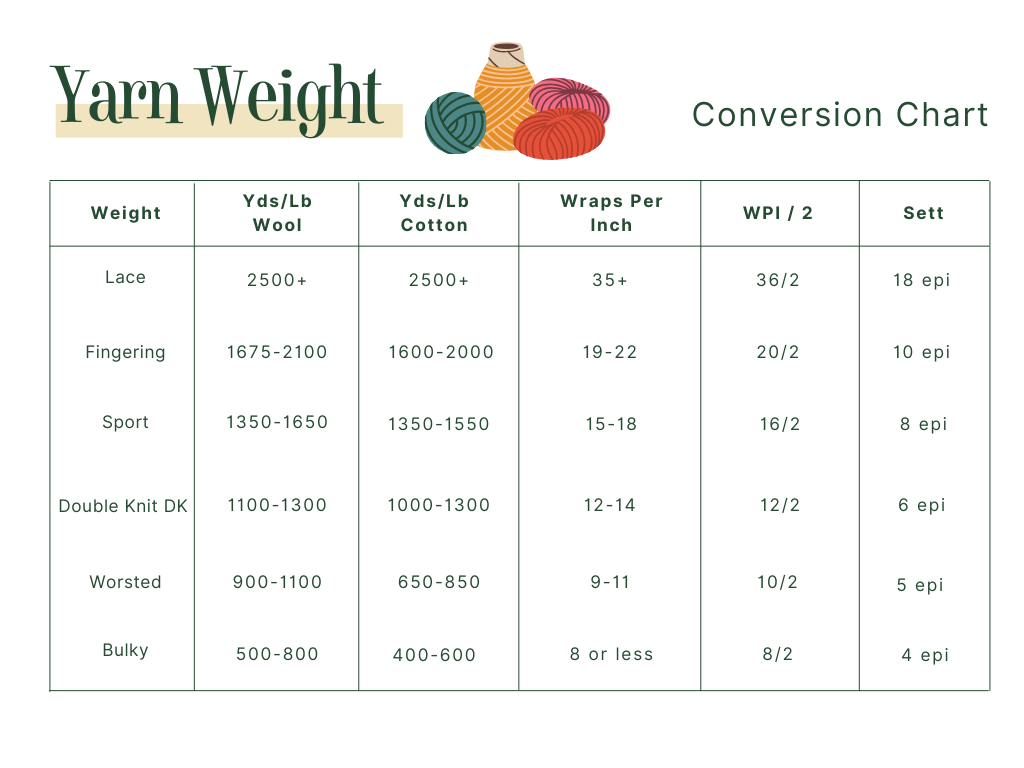
Another method used to describe weaving yarns is ‘yards per pound'. It is a simple method in that the more yards per pound the thinner the yarn is. Yards per pound is noted on the knitting yarn chart as a way to help convert knitting/crochet yarn weights into an equivalent in weaving yarns.
The last method that you commonly see to describe weaving yarn is wraps per inch, or WPI. (You will also see knitters using this term sometimes, and it is also common among spinners to describe their hand-spun yarn.) WPI is valuable to weavers as it is a good place to start when you are figuring out how to weave a project.
In a contrast to knitting yarns weaving yarns are not washed before they are shipped out. This helps the yarn better resist the greater friction of the weaving process versus the knitting process.
Handwoven's Master Weaving Chart is also a good resource for finding the sett of most yarns. *Sett is how a weaver describes how many warp (vertical) threads per inch that makes up the cloth they are weaving.
Yarn Weight Conversion Chart
Weaving Sett Charts
How to Determine Yarn Weight Without a Label
Wraps per Inch Method
Wraps per inch (WPI) is a method often used by weavers, but it can also be useful for any yarn lover to figure out the yarn's weight when the label is missing.
To determine WPI, you’ll need a ruler and an object with a uniform circumference (a pencil, crochet hook, or knitting needle would work) to wrap your yarn around.
Start by wrapping the yarn around the pencil for several inches, making sure the wraps are snug and sit side by side without overlapping or leaving big gaps and avoid pulling too tightly so your measurement isn’t distorted.
Tip: If you’re not confident about your tension, practice first with yarn of a known weight.
After wrapping, count how many times the yarn goes around in one inch using your ruler, and measure the number of wraps in a few different spots. Then, compare your WPI number to a weight category chart to decide the yarn's weight and choose the right hook or needle size to get the proper gauge. Remember, WPI is a subjective method and results may vary depending on how tightly you wrap the yarn, so making a gauge swatch is recommended before launching into your project.
Determining a Weaving Sett from Wraps per Inch
To guesstimate a weaving sett from wraps-per-inch, divide the wraps-per-inch by two to get an approximate sett for plain weave. By reducing the number of yarns in an inch by half, you leave room for the weft to go over and under the warp. If you are weaving lace, the sett will be a bit less than the plain weave sett. If you are weaving twill, it will be a bit more than the plain weave sett.
For example: For a piece of cloth that has a balanced weave (the same number of threads going horizontally and vertically within an inch) a yarn that is 24 wraps per inch will be sett* at 12 ends per inch when you weave. If a weaver asks you what the set of a yarn is you can refer to this chart. Just remember that is not a hard and fast rule. There are many variables that factor into that decision, but the best way to figure out what will work best for your project is to make a sample!'
Gauge Swatch Method
Another approach involves creating a gauge swatch. Making a test swatch means knitting or crocheting a small square usually around four inches wide by four inches tall using the yarn in question in simple knit or single crochet stitches. By comparing this sample to recommended needle sizes, yarn weights, and your own tension, adjustments can be made as needed; for example, changing the needle or hook size can help the swatch better match the intended yarn weight.
